Wolf Range Hood Repair
Ducted or Recirculating? What Totem Lake's Podium Buildings Allow Above a Wolf Rangetop
In Totem Lake's podium buildings a kitchen hood is not the homeowner's to specify: exhaust either joins a shared riser sized for the building or the unit recirculates through charcoal. That is why a hood that stopped pulling here is usually a filter and blower-wheel job, not a duct job.
Rafael Monteiro Cooking-appliance technician — ventilation and blowers · 9 years in the trade
The call we take most often here
In Totem Lake it is nearly always the same complaint: the hood runs, and the kitchen fills anyway. In a podium building that is a filter and blower-wheel problem far more often than a ducting problem, because a large share of these kitchens were never ducted to the outdoors in the first place — the hood recirculates through a charcoal filter and returns the air to the room.
Totem Lake is Kirkland’s designated Urban Center and the place the city has aimed its growth at. The 26-acre Village at Totem Lake replaced the failed mall on the site, which was purchased in 2015 with redevelopment announced in 2016, and the surrounding blocks have filled with podium-style housing over retail and parking. Bell Totem Lake alone accounts for 202 units.
None of that construction type is unique to Kirkland — podium multifamily behaves the same way in any city. What is local is the concentration. Totem Lake has more of this stock, and newer, than anywhere else we cover, which is why the same call arrives from those blocks over and over while Juanita, Houghton and Bridle Trails send us something else entirely.
Why this address produces it
Because in a podium building the hood is not yours to specify. Kitchen exhaust either enters a shared vertical riser sized for the load the building was originally designed around, or the unit is on recirculation. Either way the ceiling on what your kitchen can move was set years before you chose an appliance, and a 900 CFM ducted hood is generally not on the menu regardless of what the cooking equipment beneath it deserves.
That matters most where a Wolf rangetop has gone into one of these kitchens. The appliance is capable of producing a great deal of heat, steam and grease-laden vapour very quickly, and a recirculating hood removes none of it from the dwelling. It captures grease in the mesh, adsorbs some odour in the charcoal, and hands the heat and the moisture straight back to the room.
Contrast that with the rest of the city. A Bridle Trails house with an island hood over the block has its own duct, its own termination and its own damper, so when that hood stops pulling the fault genuinely is somewhere in the run. Houghton, where pro ranges have been dropped into original cabinetry, sits in between: a real duct, but often a short and awkward one. Juanita’s tight galley remodels above the bay have the same duct question in a smaller room. Totem Lake is the one where the answer is frequently that there is no duct at all.
The chain, from cause to complaint
A recirculating hood fouls in a specific order, and knowing the order tells you where to look.
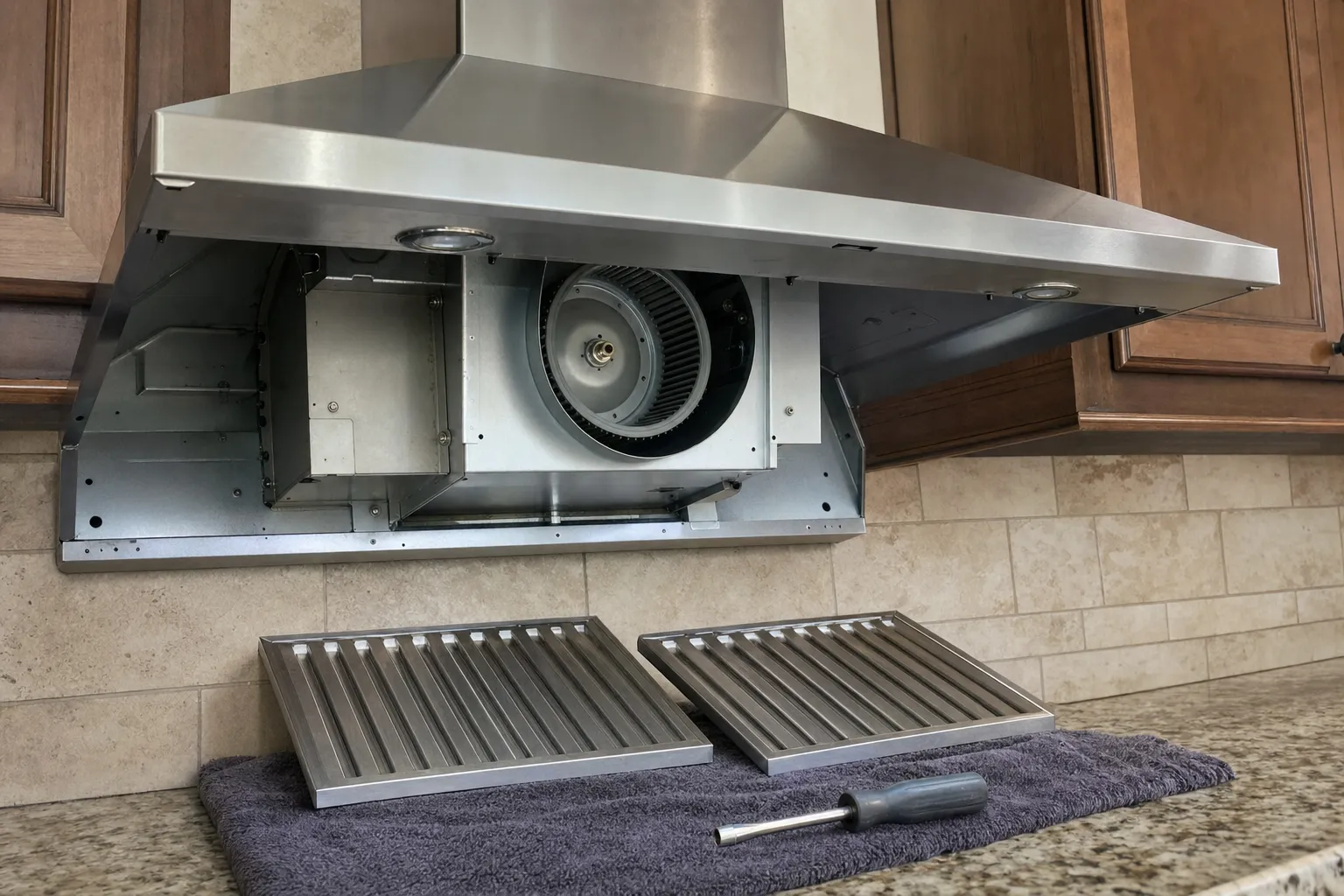
Grease aerosol leaves the cooking surface and hits the mesh or baffle filter. Whatever the filter does not catch continues into the blower housing, where it lands on the wheel. A blower wheel is a set of small curved blades, and a coating on those blades does two things at once: it changes the shape of each blade, so the wheel moves less air at the same speed, and it distributes weight unevenly, so the wheel goes out of balance. That is the rattle and howl people report on the top two speeds.
Meanwhile the charcoal filter behind the blower is saturating. Charcoal has a finite capacity and no visible indicator, so unlike a greasy mesh it gives no warning at all. As it loads, resistance rises and airflow falls further.
The end state is a hood that is running hard, sounding worse than it used to, and clearing nothing. The motor is often still perfectly healthy at that point — but it will not stay that way, because an unbalanced wheel wears bearings, and a restricted system makes the motor run hot.
Ruling out the obvious first
First, establish whether you are ducted or recirculating, because half the advice on the internet does not apply to you if you are not. Look for a charcoal filter behind or above the mesh; look outside for a wall cap or a roof termination serving your unit; check the documents the builder left. In a podium building, ask the building manager rather than guessing.
Second, pull the mesh or baffle filters and degrease them properly. Hot water and dish detergent, or a dishwasher cycle if the manual permits it. Do this on a schedule, not when the hood misbehaves.
Third, replace the charcoal if you are recirculating. Follow the interval in your manual and treat it as a consumable, because nothing about its appearance tells you it is finished.
Fourth, look into the blower housing with a torch. A visible grey-brown film on the wheel blades is your airflow problem, and cleaning it — carefully, with the power off at the breaker — often restores most of the performance and quietens the noise.
Fifth, check the lights and controls separately. A dark lamp bank or a control that has stopped responding is unrelated to airflow and points at the wiring, the switch or the board.
When it stops being a homeowner job
Stop when the blower still will not switch off, or starts on its own, or only stops at the breaker. Stop when the motor is noisy after the wheel has been cleaned, when it hums without turning, or when it smells hot. Stop if the controls are dead on one side. And stop before removing anything structural in a podium building — shared risers and the sealing between units are not a place to improvise.
On price: hood work has no fixed band of its own. A blower, a speed control or a lamp fault is quoted after the diagnosis, as one figure for parts and labour, before anything is ordered.
$89 covers the visit and a real diagnosis rather than a parts guess. The number is (425) 699-2400, and booking online through this page reaches the same schedule. Mention whether your hood vents outside or recirculates; if you do not know, say that instead and we will settle it on site.
Common follow-ups
How do I tell whether my Totem Lake condo hood is ducted or recirculating?
Look for a charcoal filter sitting behind or above the metal mesh — its presence means recirculation. Then look for an exterior termination serving your unit, either a wall cap or a roof outlet. Builder documentation usually says outright, and in a podium building the property manager will know, since kitchen exhaust design is a building-wide decision rather than a per-unit one. If none of that resolves it, we can confirm it on the visit.
Can I upgrade to a high-CFM ducted hood over my Wolf rangetop in a podium building?
Usually not on your own initiative. Exhaust in these buildings either shares a vertical riser sized for the original design load or does not leave the dwelling at all, and altering that affects other units and the building envelope. It is a question for the association and the building's own engineer before it is a question for an appliance company. Within those limits, keeping the existing hood genuinely clean is where the real improvement lives.
How often should I change the charcoal filter if my hood recirculates?
Follow the interval in your manual and treat it as fixed maintenance rather than something you judge by eye. Charcoal saturates invisibly — it looks identical when it is finished — so there is no inspection that tells you. If you cook frequently on a Wolf rangetop, the shorter end of the recommended range is the sensible default, and it should be paired with degreasing the mesh filters far more often than that.